We'd rather write it off than sell it wrong.
Brands reject low offers to protect pricing — but the grey market doesn’t wait. While inventory gets written off, the same products quietly resurface at even lower prices. The real question isn’t whether the offer is low — it’s what your product is already trading for.
Pollen Direct Team
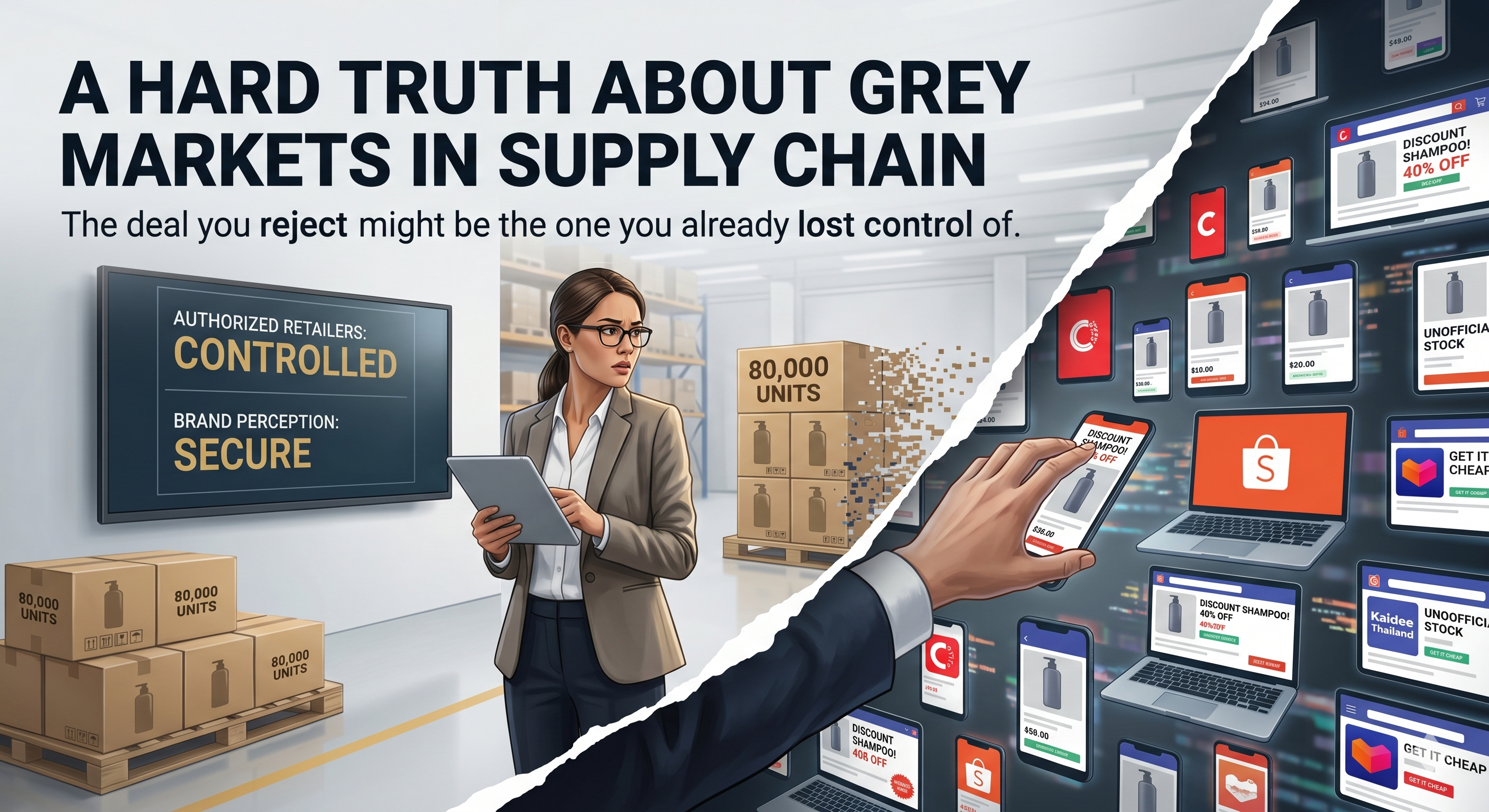
A Hard Truth About Grey Markets in Supply Chain
A supply chain manager at a global beauty brand said this to me during a negotiation. She meant it. I’ve heard versions of it from a dozen people since.
The Fear Makes Sense
You’ve got 80,000 units of slow-moving shampoo sitting in a warehouse.
You find a buyer willing to take the lot at 30 cents on the dollar.
But if that buyer turns around and dumps it on Shopee at 25% of retail:
You undercut your retail partners
You train consumers to expect discounts
You damage brand perception
You create a mess that takes months to fix
So you say no.
You write it off. You take the loss.
The Part Nobody Tells You
The grey market doesn’t care what you decided.
While you’re writing those units off, someone else is moving them:
A broker who knows a warehouse manager
A distributor quietly clearing excess stock
An importer handling a cancelled order upstream
Your product is already on Kaidee in Thailand.
It’s already on Carousell Singapore.
The exact SKU you refused to sell is now listed at 40% below retail.
What Actually Happened
Rejecting the offer didn’t stop the leakage.
It just removed your control from the transaction.
The Insight That Changes Negotiation
When finance teams block a deal, they ask:
“Is this price good enough?”
But that’s the wrong question.
The real question is:
“What is your grey market floor right now?”
Why This Changes Everything
If your product is already trading at 20% of retail in the grey market:
Then a vetted buyer taking inventory at 30% of retail with:
Signed waivers
Channel declaration
Controlled distribution
…is actually raising the floor, not lowering it.
The Shift in Pitch
The conversation changed from:
“Here’s why you should accept this offer.”
To:
“Here’s where your product is already trading — and here’s what this deal fixes.”
How We Prove It
We build the evidence manually:
Search Carousell, Shopee, Lazada, Kaidee
Find the exact SKU
Capture price, seller, and listing date
Compare it against the buyer’s offer
The Real Argument
You’re not protecting your brand by refusing the deal.
You’re just opting out of the version you could control.
What Happens Next
This process works — not always, but enough to change decisions.
Now the next step is obvious:
Automation.
A system that:
Takes a brand and SKU
Scans marketplaces automatically
Surfaces real-time grey market pricing
So this insight happens before negotiation, not after it stalls.
The Endgame
When that happens, this isn’t a defense anymore.
It becomes the opening line:
Here’s where your products are trading today.
Here’s what we can do about it.