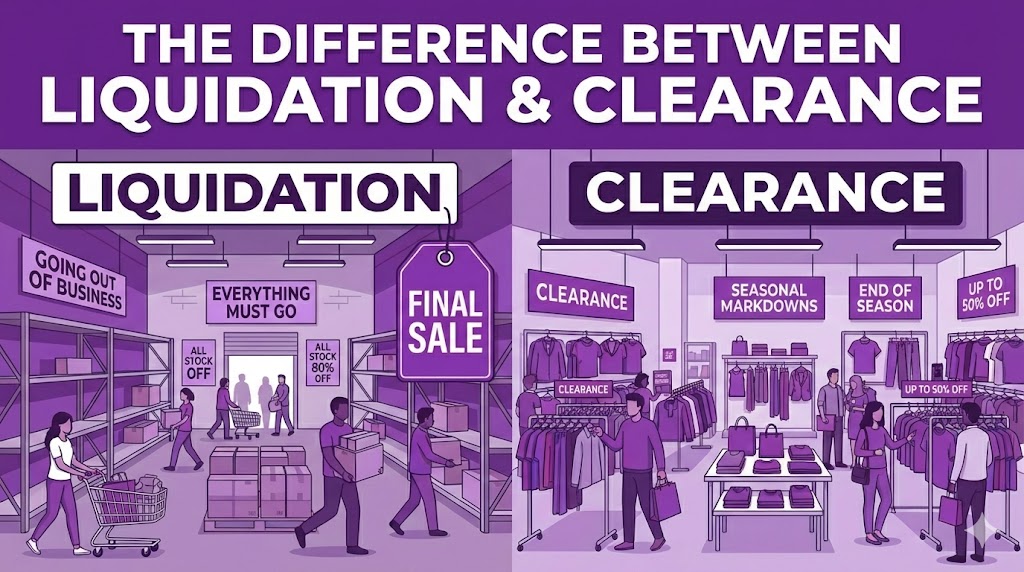
In retail, the terms "liquidation" and "clearance" are frequently and incorrectly used as synonyms. While both involve selling products at a discount, they serve fundamentally different strategic goals, target different audiences, and carry vastly different implications for a brand's long-term health. Understanding this distinction is crucial for optimizing your recovery value and protecting your brand equity.
What is Clearance?
Clearance is a Controlled Retail Strategy designed to move seasonal, discontinued, or slow-moving stock within a brand's primary retail channel.
Key Characteristics of Clearance:
Goal: To make space for new, incoming stock on the current sales floor and recover capital quickly, often before a new season starts.
Target Audience: The brand's existing customer base.
Pricing: Discounts are typically moderate to significant (e.g., 20% to 50% off), but the brand maintains full control over the price ladder.
Impact on Brand: Generally minimal, as the sale is controlled and expected by customers (e.g., "End-of-Season Sale"). It trains customers to expect seasonal discounts but doesn't usually devalue the core product line.
Channels Used: Direct-to-Consumer (DTC) channels, owned stores, and authorized e-commerce sites.
When to Use Clearance:
Moving items that are still in good condition and sellable to your existing customer base.
Closing out the last few units of a previous season's line.
When the inventory volume is manageable and doesn't pose a severe long-term warehousing problem.
What is Liquidation?
Liquidation is an Asset Recovery Strategy designed to dispose of excess, obsolete, returned, or near-expiry inventory outside of the primary sales channel to minimize financial loss and avoid channel conflict.
Key Characteristics of Liquidation:
Goal: To maximize the recovery rate on assets that are no longer viable for the primary retail market and free up warehouse space. The focus is on volume disposal.
Target Audience: Secondary markets, resellers, B2B buyers, international markets, or specialized off-price retailers.
Pricing: Prices are heavily discounted (often 60% to 90% below retail) and determined by the secondary market value, typically via bulk sales or auctions.
Impact on Brand: High risk of devaluation and channel conflict if not handled discreetly. Modern specialized liquidators use geo-fencing and controlled channels to mitigate this risk.
Channels Used: B2B liquidation platforms, private auctions, specific outlet partners, or donation/recycling centers.
When to Use Liquidation:
When you have high volume of stock that cannot be sold through normal clearance (e.g., thousands of units of a failed product line).
Handling customer returns and open-box items that require grading and processing.
For near-expiry items (especially in FMCG) where speed is critical.
When the product has become completely obsolete and poses a carrying cost liability.
The Strategic Difference: Control vs. Disposal
Feature | Clearance | Liquidation |
Primary Goal | Space creation; generating cash flow from slow stock. | Loss minimization; maximum asset recovery on obsolete stock. |
Pricing | Fixed price ladder (20% -> 50% off). | Bulk/Auction pricing (often 60%+ off). |
Channel | Primary DTC/Retail channels. | Secondary B2B and non-competing channels. |
Audience | Brand's own customers. | Vetted resellers/liquidators. |
Brand Risk | Low (if managed well). | High (requires specialized control). |
Conclusion
Brands must treat clearance and liquidation as separate arms of their inventory strategy. Clearance is a sales tactic used to finish a season. Liquidation, especially when using specialized partners, is a critical asset management discipline used to protect brand integrity while sustainably disposing of massive liabilities. Choosing the wrong strategy for your inventory volume or condition can instantly damage your market pricing and retailer relationships.
How Pollen Helps
Whether you choose clearance or liquidation, Pollen provides tools and a marketplace to help businesses recover value, avoid waste, and simplify inventory management. Our platform matches your stock with the right buyers and pricing strategy — fast, transparent, and data-powered.
Ready to turn your excess inventory into opportunity? Learn how Pollen helps businesses clear stock smarter.