The Rising Cost of Disappearing Waste: Why the Modern Carbon Tax Changes Everything for Inventory Strategy
With the carbon tax rising to S$45/tonne, disposing of excess inventory is no longer just an environmental issue—it's a massive balance sheet liability. Here is how modern businesses are restructuring their asset lifecycle to hedge against rising regulatory costs.
Pollen Direct Team
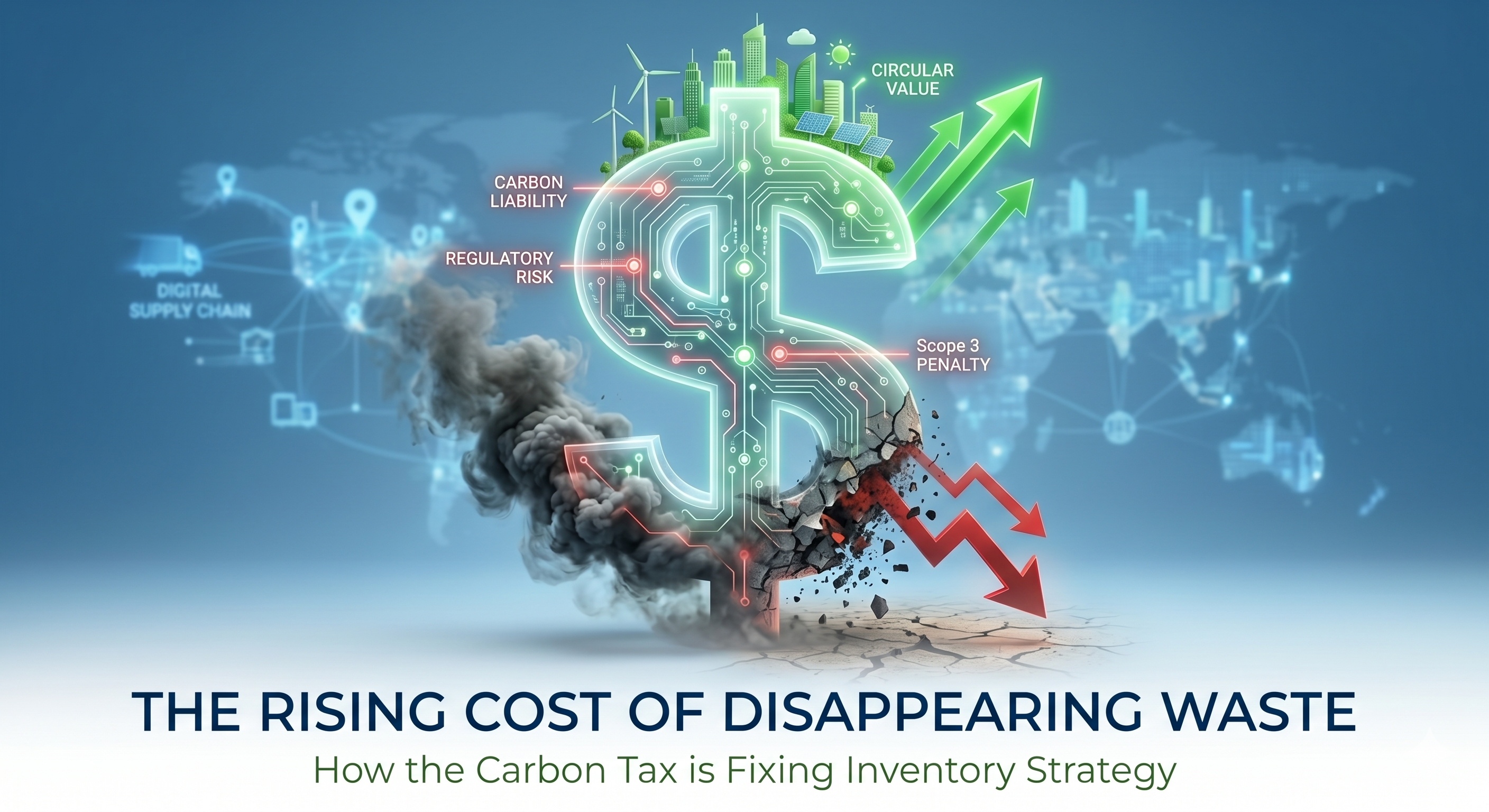
For years, many businesses handled excess inventory, factory overruns, and product returns using a simple accounting formula: if the cost of storing it exceeds its projected clearance value, make it disappear. Whether through deep landfill dumping or commercial incineration, commercial waste was treated as an inevitable, minor cost of doing business.
But in 2026, the economic math behind "throwing things away" has fundamentally broken.
With Singapore declaring the Year of Climate Adaptation and the national carbon tax climbing sharply to S$45 per tonne, corporate waste is no longer just an environmental metric tracked in an ignored ESG report. It has officially transformed into a high-stakes line-item liability on the corporate balance sheet.
If your business model still relies on traditional disposal to manage surplus assets, you are exposing your company to massive financial and regulatory risks.
The Double-Taxation of Excess Inventory
When a company disposes of perfectly usable commercial goods, it unknowingly triggers a financial penalty cycle.
First, there is the sunk operational cost—the capital spent on raw materials, manufacturing, shipping, and warehousing for items that never generated revenue. Second, there are the escalating disposal fees as municipal landfills tighten capacity. Finally, under modern environmental frameworks, industrial waste and destruction add directly to a company’s scope 3 carbon footprint emissions.
As carbon pricing mechanisms tighten across global supply chains, businesses are essentially being taxed for creating products, and penalized heavily again for destroying them.
The strategy of writing off inventory as a tax loss while physically dumping it into the ecosystem is no longer a viable financial shortcut. In the current regulatory landscape, physical waste is lost capital.
The New Financial Framework for Asset Lifecycles
To hedge against these rising compliance costs, Chief Financial Officers (CFOs) and procurement directors are shifting from traditional damage control to proactive transition planning.
Managing excess inventory in a high-carbon-tax economy requires adhering to three financial principles:
1. Mandatory Waste Traceability
You cannot manage what you do not measure. Forward-thinking financial audits now require complete lifecycle tracing of all physical assets. If a batch of products leaves your warehouse, your accounting team needs verifiable data on where it ended up. If it was destroyed, the financial liability must be calculated immediately. If it was safely re-circulated, that carbon mitigation can be factored into your corporate valuation.
2. Shifting to Value Recovery over Liquidation
Traditional B2B liquidation focuses solely on squeezing a few cents on the dollar out of a product, completely ignoring the carbon asset value. Modern asset strategy looks at product redistribution as a form of Resource Recovery. Finding secondary markets, alternative B2B users, or industrial repurposing channels prevents the product from triggering a carbon penalty, creating a dual financial win: immediate capital recovery plus carbon tax avoidance.
3. Hedging Against "Scope 3" Liabilities
For small and medium enterprises (SMEs) operating within larger global supply chains, the pressure is mounting from the top down. Multinational corporations are actively auditing their vendors. If your business supplies a larger global brand but manages its internal waste irresponsibly, your high carbon footprint makes you a liability to their corporate climate targets. Protecting your supply chain relationships now requires a zero-landfill inventory protocol.
Turning Liability into Compliance Capital
The rising carbon tax should not be viewed merely as a punitive corporate burden. Instead, it serves as a powerful market signal that the era of linear supply chains—take, make, waste—is officially drawing to a close.
By deploying automated resource tracking, private redistribution networks, and circular asset models, businesses can safely turn excess stock from a heavy regulatory liability into a strategic compliance advantage.
The companies that survive and thrive over the next decade will be those that realize the cheapest way to handle a piece of excess inventory is never to let it become waste in the first place.